“It is no measure of good health to be well-adjusted to a profoundly sick society”
Instagram is a paradigmatic example of how we can participate in ideologies without personally believing in them. We all know that social media isn’t “real”; that it’s making us desperately sick and anxious and existential; and that we would be much better people without it. I believe these are among the most widely-discussed and agreed-upon facts among all (but especially young) generations. And yet what comes of it? None of this widely-circulated knowledge about the psychological damage we suffer, the false expectations, the canned happiness, stops us from behaving as if Instagram really were real; as if we were not all desperately sick and anxious and existential; as if everything were just fine. Why is this the case?
I recently learned about the idea of “transference,” which, in the work of philosopher Zlavoj Zizek, is when we outsource a social obligation onto another entity, which performs it on our behalf. Zizek explains the concept using the example of laugh tracks in TV shows, which don’t just tell us when to laugh, but actually absolve us of our obligation to laugh: “So even if, tired from a hard day’s stupid work, all evening we did nothing but gaze drowsily into the television screen, we can say afterwards that we had a really good time.” The idea that we depend on external objects to perform our ideological debts is important because it explains how we can disavow ideology on the level of our speech, while still being materially invested in its reproduction. Just think of filthy-rich Pentecostal preachers who harp that it isn’t the commodities in life that make one wealthy, but one’s faith, friends, and family. Of course, regardless of what the preacher is spouting off, his social position and possessions “believe” in capitalist ideology in his stead. Transference is an important way we perpetuate ideology because even though we outwardly claim not to be “true believers,” our ideological commitment is already inscribed in an object or institution, which operates independently of our stated personal belief.
We can use the idea of transference to make sense of the apparent contradiction between having a personal Instagram account while denouncing its toxic social effects. When we make a personal social media account, we outsource an ideological obligation—namely, demonstrating to the “Big Other” that we are overjoyed with our lifestyle—to our online profile, a handoff which allows us to subsequently denounce the horrors of the digital ecosystem. We relinquish the social pressure to be sparkly, glowing, and defiantly happy to a digital portfolio which, like a laugh track, doggedly broadcasts enjoyment on our behalf. It doesn’t matter that everyone thinks the pressure to be content all the time is objectively unrealistic or stupid. The fact is that, on a material level, our profiles shriek with glee incessantly, creating a yammering cacophony of ecstasy that rattles on and on in the background of life. Ideology doesn’t rely on true, hardcore believers, but rather a mass of cynical, self-aware, but nevertheless willing participants. Thus, we profess disgust at the dystopian effects of social media while polishing our profiles, which we openly acknowledge are completely fictional constructs.
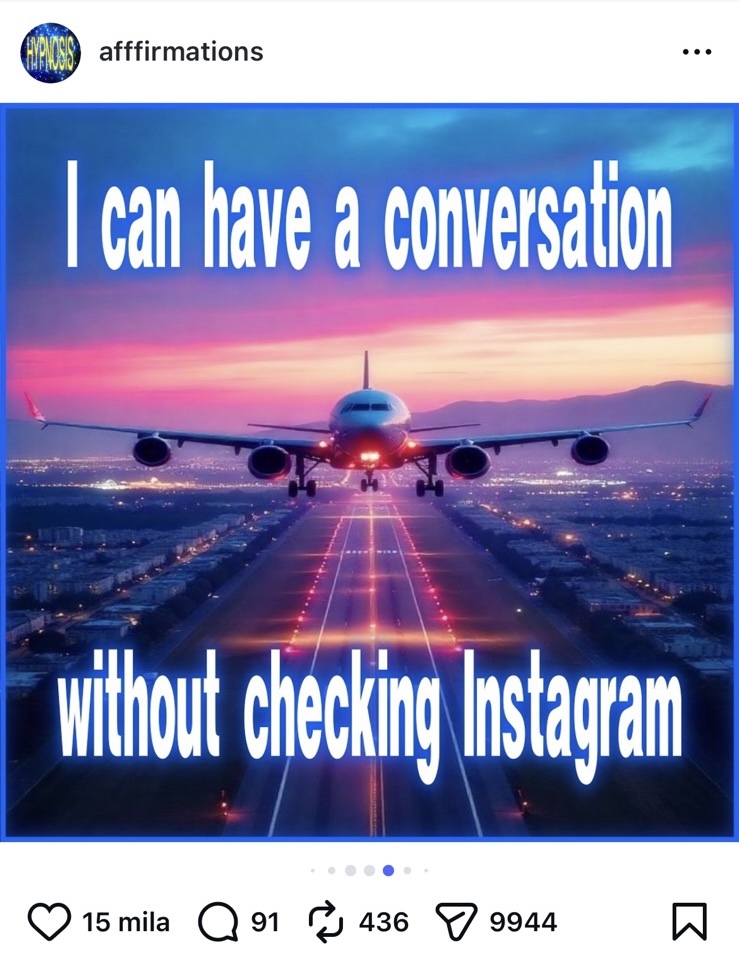
Nowhere is this acknowledgement more open than in accounts like “Affirmations 🌐 Global Self Hypnosis.” In case you are uninitiated, these marvelous accounts take the alienation of capitalist ideology—specifically as it intersects with social media—to the extreme, mocking corporate speak and the empty, performative pressure that we feel constantly compelled to display.
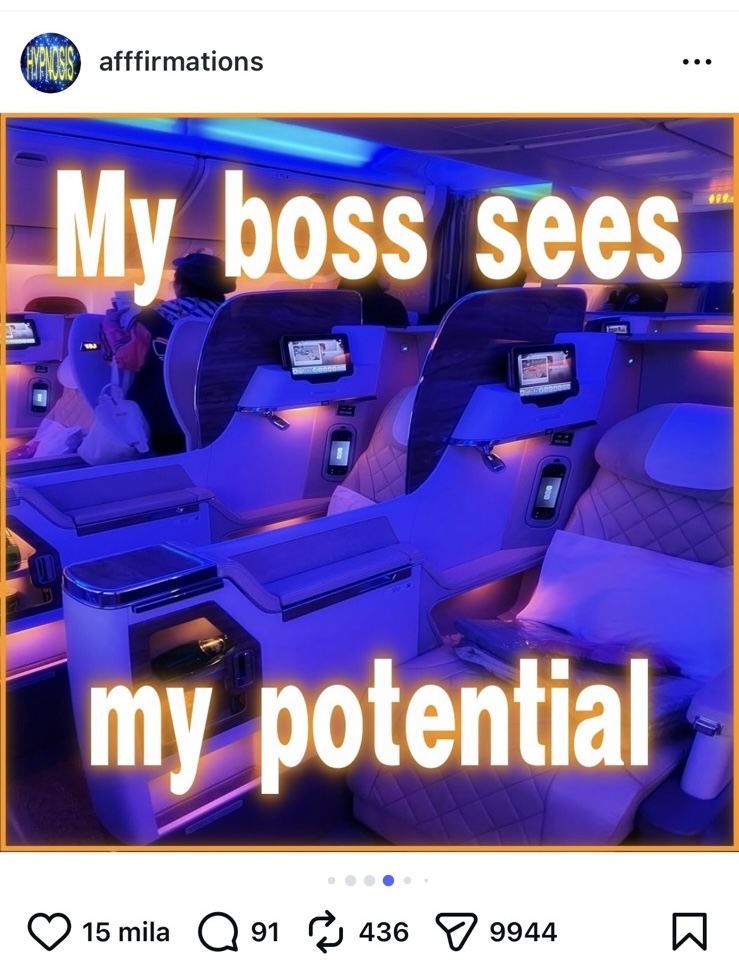

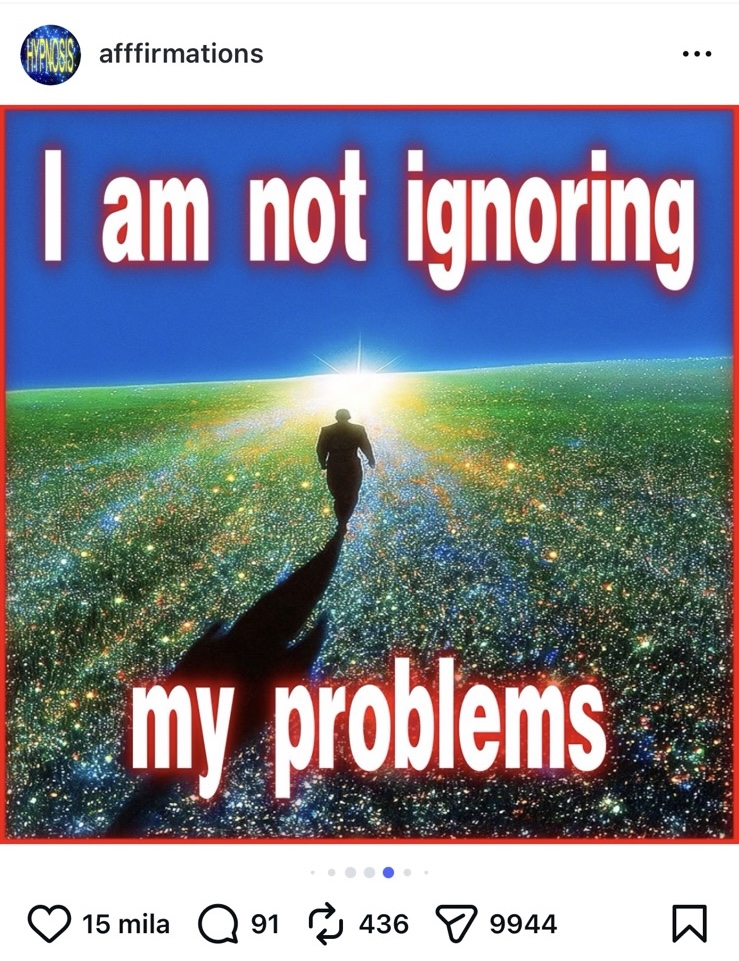
These accounts satirize the sloganized world of self-improvement, iterating on the quaint ring of such hits as “be your own boss,” “rise and grind,” and “protect your peace.” The idea that individuals have agency over their psychological well-being in a world hurtling towards self-destruction is appropriately treated as a sick joke. Underlying these memes is a shared understanding that the idea of free will is used by capitalist ideology as a tool of mass manipulation—and yet, the patronizing goop of self-improvement clichés staggers on, like a dead man walking.
These accounts’ self-awareness is beautifully ideological since, while they satirize neoliberal self-improvement and self-surveillance, they do so within the digital platforms that constitute the ideology’s black heart. The only way to take an ironic distance from doctrine is to first pay the piper: almost everyone who views these memes is an active participant in the social media wasteland. By maintaining gleaming personal profiles, we transfer the social obligations demanded by capitalist ideology—namely, making blaring declarations of excessive delight—to a digital entity. And with this transference out of the way, we are free to be depressed and make self-deprecating memes about the ridiculous pressure to be carefree.


The same principle of transference applies to going about a “normal, successful” life more generally. A succinct example occurred to me last year, while I was writing blogs for a company that helps startups get bought. Part of my job was listening to interviews with the founders of startups that got acquired through our company. In one interview, an entrepreneur set a personal goal for himself to become the CFO of a medium-sized company by 40, a goal which he positively smashed, reaching it by 38! But inside, he felt empty. He realized that there was more to life than climbing the corporate ladder. And then he said: “And that was when I decided to start my own start-up.”
I was fascinated by his ability to clearly articulate his distaste for “traditional” success. He had fully renounced what he—correctly—identified as an ideological complex that structured his desire and guided his free will. He was perfectly aware that the capitalist vision of happiness was a vicious falsehood, that it did nothing but distract him from deep, traumatic doubts about his existence; he saw that his professional ambitions were ever-moving goalposts that he used to distract himself from a gaping hole inside. And yet, upon winning—and supposedly renouncing—the rat race, he just switched hamster wheels and became a different stripe of entrepreneur.
We have a remarkable capacity to recognize the American dream as sad, tragic, and empty, and yet still act as if it were not. Thanks to the mechanism of transference, it doesn’t matter if we’re happy: our commodities are happy for us. Our job title, our watch, our neighborhood—these things broadcast ideological buy-in, compliance, success, and wholeness structurally; automatically; before we even speak—in a word, they service our debt to capitalist ideology so that we don’t have to. We all agree it’s ridiculous that this is the case; that, of course, a car or job is no measure of a person’s character. And yet, only once we have performed the song and dance for the LinkedIn Gods are we free to complain about how stupid the whole thing is. Only once we reach the goals laid out for us by corporate society in middle age and then become severely depressed, can we renounce the hollowness of that lifestyle. But by that point, what is left but pursuing the sweet treats we spent our whole life working towards?
It’s well-recognized that we are all bought into “the system” on a material level, since no matter how much we denounce it, we depend on a handful of multinationals for almost all necessities of life. What is less discussed is our libidinal investment in capitalist ideology; that is, the fact that we actively enjoy participating in the system, even as we oppose it. Indeed, as the practice of “Global Self Hypnosis” demonstrates, even the joy of mocking capitalist ideology takes place on platforms that actively reproduce it. This paradox produces the mass cynicism and irony that underpins our engagement with social media, and indeed with all ideology. Whether on self-aware meme accounts or our own profiles, the main goal is to pay our tithes to ideology while creating as much ambiguity as possible about whether we’re being ironic or sincere.
Until next time,
Lucas