According to the Google AI Overview, a pile driver can refer to “a devastating wrestling move where an opponent is dropped head-first onto the canvas, a heavy piece of construction machinery, or an advanced sexual position.”
As I lay my head down for an afternoon nap, it was the second meaning of the word that I cursed. The pile driver was the core piece of hardware in the three-pronged, excavator-mounted jackhammer eating away at the small mountain thirty meters behind my window, penetrating my bedroom with a sporadic chorus of steel against weathered schist. I watched the forked arm struggle insistently against the mountain like a serrated knife raking the side of a frozen, noncompliant stick of butter.
The potential advantages of jackhammers had been obvious to the king of the Savoyard state, Carlo Alberto, since 1843, when he conceived of a 12-kilometer tunnel through Mount Fréjus to connect Italy and France by rail. The forward-thinking royal understood that to make way for the future, destruction had to be administered with precision and efficiency. However, it wasn’t until 1851 that Joseph W. Fowle, an American, used compressed air to drive a piston crosshead in its shaft, making the first proper pneumatic drill. Fowle’s noisy, unwieldy contraption was right at home among the din and smokestacks of industrializing Philadelphia, and iterations on his patent soon flourished. Some innovators incorporated electric motors, rotary screw compressors, and hydraulic hoses into the jackhammer; others pursued ergonomic improvements to reduce carpal tunnel syndrome in the device’s practitioners.
By its 100th birthday, Fowle’s machine had achieved world domination in the business of surgically precise demolition. Great public works were undertaken by nations with the wealth of empire at their fingertips. Cement became the most-used material by humans after water, and the corresponding need to break cement rose dramatically. The birth of the megaproject—a screeching, grime-spewing thing—was midwifed by an immaculate linguistic register developed at conference tables in air-conditioned Safe Spaces. Words stacked with the plosive P bounced energetically around boardrooms like pinballs: progress, production, Public-Private Partnership. Punch-packing shibboleths ricocheting off Free Trade Agreements and Memorandums of Understanding to earn multipliers, skillshots, and add-a-balls. The End of History was a high-entropy, self-congratulatory lexical arcade, firing on all cylinders wherever cement could be poured. And clinging to the underside of globalization, the forward march of civilization, was the jackhammer—a noisy leech, a specialist in All Things Obliteration, the ear-splitting henchman of the imperative to build!
As I buried my face in my pillow, one hundred and seventy-seven-years of the instrument’s cacophonous, miasmic existence were compressed into a single, infinitely looped point of collision, radiating jolts across a blanket of silence. Two centuries of the insatiable masculine urge to destroy and remake the world channeled into clockwork steel organs that exploded in insufferable staccato. Decades of patenting and iteration, of carpal tunnel syndrome, of carving out mountains to connect the Savoyard state by rail, condensed into one piece of internal hardware which propelled itself suicidally, over and over, into a spade tip: the pile driver.
Indeed, as I stared at the word’s definition, sandwiched between a wrestling move and a dominating sex position, its neutral, instrumental meaning seemed to absorb the aggression and vulgarity of the words around it.
Against the cumulative force of history that resounded in each stroke of phallic steel against its target, I armed myself with Flute Meditation: Tranquil flute music from around the world. I shoved earplugs under my noise-cancelling headphones and cranked the serene multicultural soundscape to max volume. The healing tones of Ambient Ascension, Earthly Winds, and Heart Chakra blended into Oriental tracks like Sandasuri, Dhyana, and Shanti Raga Todi, their foreign names reassuring me of their authenticity. Reassuring me that somewhere, in a place where there are monsoons and people say Namaste and sit on the floor in robes with good posture, humans really do experience moments of slow bliss and somatic harmony, and here’s a taste, a melodic hors d’oeuvres, to open your imagination to what it would be like for you to experience that, too.
I reflected that the sonic embodiment of Modernity was not the ear-splitting percussion outside my window, but the mélange of layered synths and worldly wind instruments I used to drown it out. A more strategic choice might have been White Noise, with its blend of jet engines and gushing waterfalls and TV static to conceal the jackhammer flak. Or even a playlist of special acoustic frequencies (40Hz Gamma Binaural Beats) scientifically proven to stimulate deep tissue activity in the prefrontal cortex, that endlessly-fetishized region of the brain so critical in the Age of Reason.
But no sound can approximate silence. Especially not the sacred mid-summer silence that engulfed Ceuta, peninsula of northern Morocco, property of the Second Spanish Republic, as it sleepwalked into “that malignant fiveishness to which the flu sufferer awakens after late-afternoon fever dreams.” Sweat beaded on even the most idle Spaniard; the sun’s angle was still mistakable for high noon. Handheld fans pushed warm air around pointlessly. Immodest bananas split open at the seam, wafting their aroma around in a final attempt to entice a stray snacker. I sank deeper into the cavernous indent of my twin mattress, which, as a result of advanced age rather than high-tech design, molded to every ounce of my flesh.
In search of true and lasting inner peace, I went to the freezer and stared at my pint of mint chocolate chip ice cream. I ordinarily love mint chip, but this brand had a pseudo-menthol sensation that failed miserably in a rich, creamy dessert. The extra coolness stuck out too far from the cream, creating olfactory discord like cologne on someone who hasn’t showered in a week. For days, I left it alone and finished my Speculoos ice cream to avoid further chocolate-flecked disappointment. But now I was all out of Speculoos, and I was sweating from the aforementioned heat and the fact that my house was a former storage unit on the third floor of a home electronics store.
Actually, the third floor of Electrodomesticos Chaib never stopped being a storage unit; it just also became a house. However, unlike some multi-purpose homes—converted school buses or remodeled barns, for instance—Chaib’s third-floor junkyard residence lacked the quaint, antique charm of a top Airbnb listing. Guests realized they were entering a graveyard of mass-produced objects halfway up the stairwell, where a cove with a sign read “Useless Clothes.” None of the items were clothes, but all were indeed useless: a pair of boxing gloves, two tires and a hubcap, a showerhead, an amplifier, an electric kettle (all defunct). Even the rooms meant for living felt scrappy, since all the furniture was pillaged from street corners and second-hand stores. The dining tablecloth concealed sizable gaps between the planks beneath it. Residents acquired Jedi senses for locating and avoiding these slits when setting their cup on the table, but some forces are stronger than others: the deeply sunken couches that served as chairs drew diners into slumber immediately after eating.
The house opened onto a patio, which was really the roof of Chaib’s home electronics store, strewn with all the rebar, wood pallets, and birdshit proper to a roof. It was also the final resting place of five cars in various states of decomposition. How the cars ended up on the roof was a great mystery and constituted the closest thing the house had to a personality trait. The most recent census determined that one of the smaller sedans was home to a seagull family that squawked and banged around in the wee hours of the night.
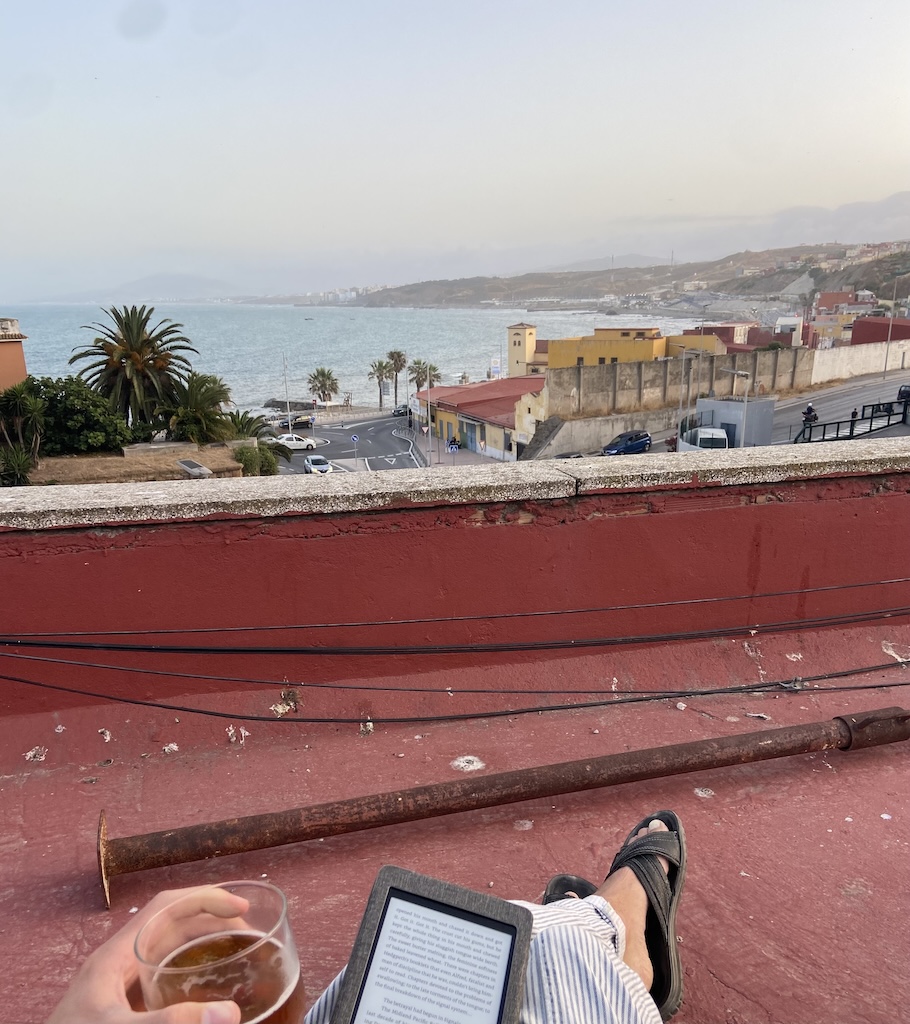
Two stray car seats overlooked the roof-patio’s edge, offering a wonderful view of the sea. Seeing such everyday objects removed from their normal station was immediately alluring, and the worn fabric and cupped backrests invited a reassuring embrace. Prospective sitters had to squat low before directing their bodyweight back into the legless chairs, though few considered how unbolting a car seat from its sturdy tracks subjected it to new dynamics of tipping and toppling. It was a calculation many guests made in slow motion, blowing past the point of no return like a texting driver through a red light. Some looked up just in time to realize their mistake. Legs extended reflexively to generate a counterweight, but only succeeded in slowing the spectacular tumble.
But for now, Electrodomesticos Chaib is home. It has a gas stove with four burners and peeling enamel. The water heater looming directly above the sink is good enough to burn your skin without warning. If you account for their odd center of gravity, the car seats on the roof can be sunset thrones. Electricity runs to most lightbulbs, outlets, and a freezer cold enough to store mint-chip ice cream. In search of true and lasting inner peace, I open the tub and take a scoop.